Imperfection Engineering Group (IEG)

Otto H. York Department of Chemical and Materials Engineering · New Jersey Institute of Technology

Overview

Defect Engineering in Crystalline Materials

Goals of Imperfection Engineering Group (IEG) are to provide a better understanding of defect structure-property relationships through accelerated modeling and simulations, and to provide materials defect genomes with a focus on defect-defect interactions. The ultimate aim is to apply the accelerated computational frameworks and genomic databases for discovery and design of engineering materials via defect engineering.
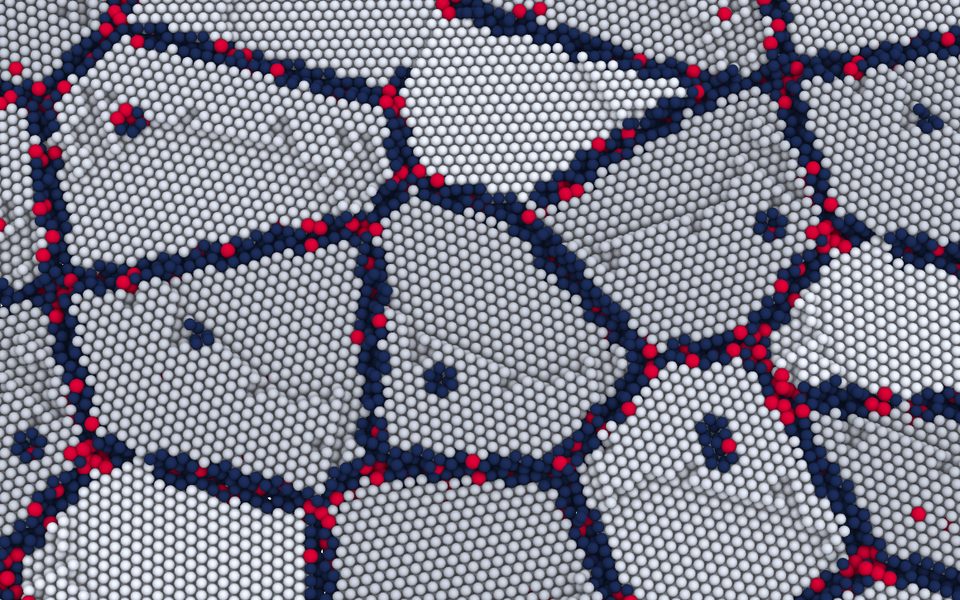
OVITO rendering of an atomistic polycrystal: grain interiors in gray, grain boundary and vacancy atoms in navy, and solute atoms segregated to grain boundaries and triple junctions in red
Research Area 1

Fundamentals of Defects in Polycrystalline Materials

We study fundamentals of defects including point defects, grain boundaries and triple junction networks to understand how they govern both localized and macroscopic ensemble properties.
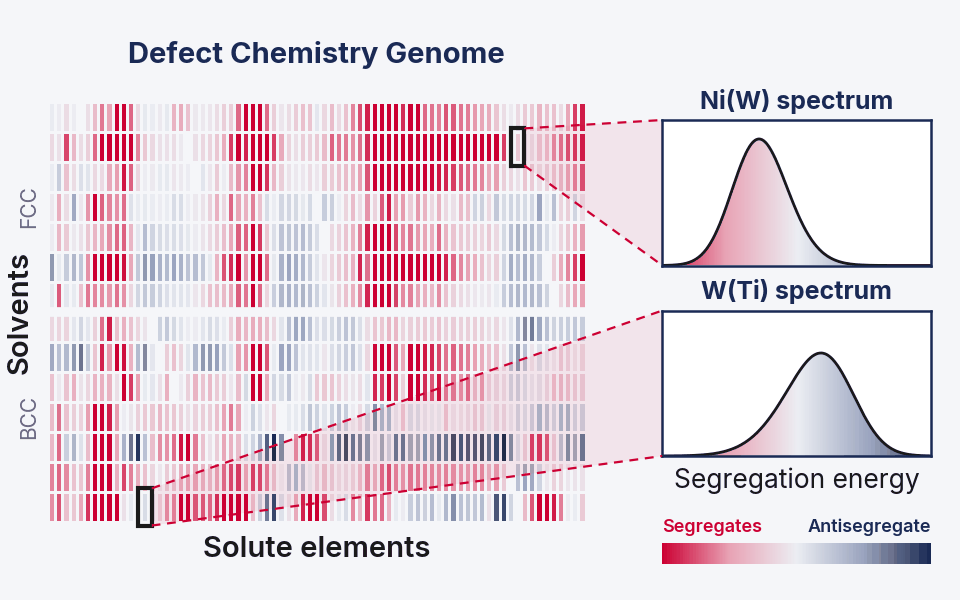
Grid of mean grain boundary segregation energies for 1,036 binary alloys (14 solvents by 74 solutes), with the full segregation energy spectra of Ni(W), which mostly segregates, and W(Ti), which mostly antisegregates, shown enlarged
Research Area 2

Materials Defect Genome

We apply ML-accelerated atomistic simulation to streamline high-throughput defect genome development for design of alloys and polycrystalline materials.
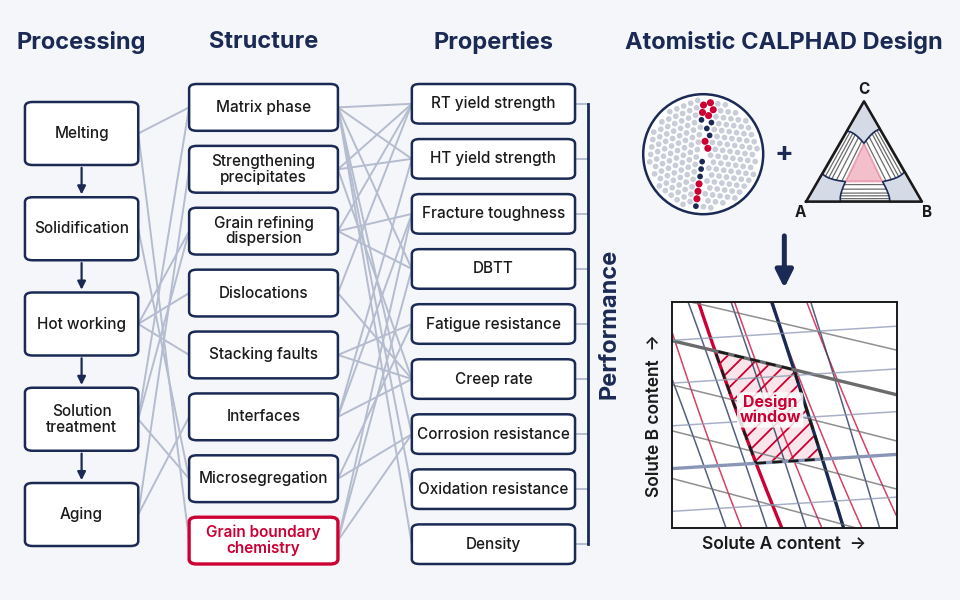
Generic system design chart linking processing steps (melting, solidification, hot working, solution treatment, aging) to structural features (matrix, precipitates, grain refining dispersion, dislocations, stacking faults, interfaces, microsegregation, grain boundary chemistry) and properties (room- and high-temperature yield strength, fracture toughness, ductile-to-brittle transition temperature, fatigue resistance, creep rate, corrosion and oxidation resistance, density), beside an atomistic CALPHAD design column: an atomistic grain boundary icon plus a ternary phase diagram feeding a parametric design plot of solute A and solute B content with a design window
Research Area 3

Computational Materials Design

We apply the system design approach to combine classical CALPHAD with the materials defect genomes we develop to design broad classes of polycrystalline materials such as metals and alloys.

Recent News

All news →